Why Mesh? The Maritime Origins of VeilMesh
How the challenge of providing secure, zero-cost communication on disconnected cargo ships birthed a revolutionary peer-to-peer messaging protocol.
When most people hear "mesh network," they think of dystopian internet blackouts or protest coordination. But the original spark for VeilMesh came from a much more practical, everyday problem: maritime logistics.
The Problem: Disconnected Oceans
Modern cargo ships are floating steel cities. They are massive, heavily compartmentalized, and inherently hostile to wireless signals. While a ship might have a central VSAT (satellite internet) connection, bandwidth is painfully slow and notoriously expensive. Crew members deep in the engine room or out on the aft deck are entirely cut off from the ship's central bridge, let alone the global internet.
Coordinating operations, responding to emergencies, or simply messaging a colleague required expensive walkie-talkies or walking up five flights of stairs. We needed a messenger that didn't require a central router, didn't use the expensive satellite uplink, and could penetrate the steel bulkheads of a vessel.
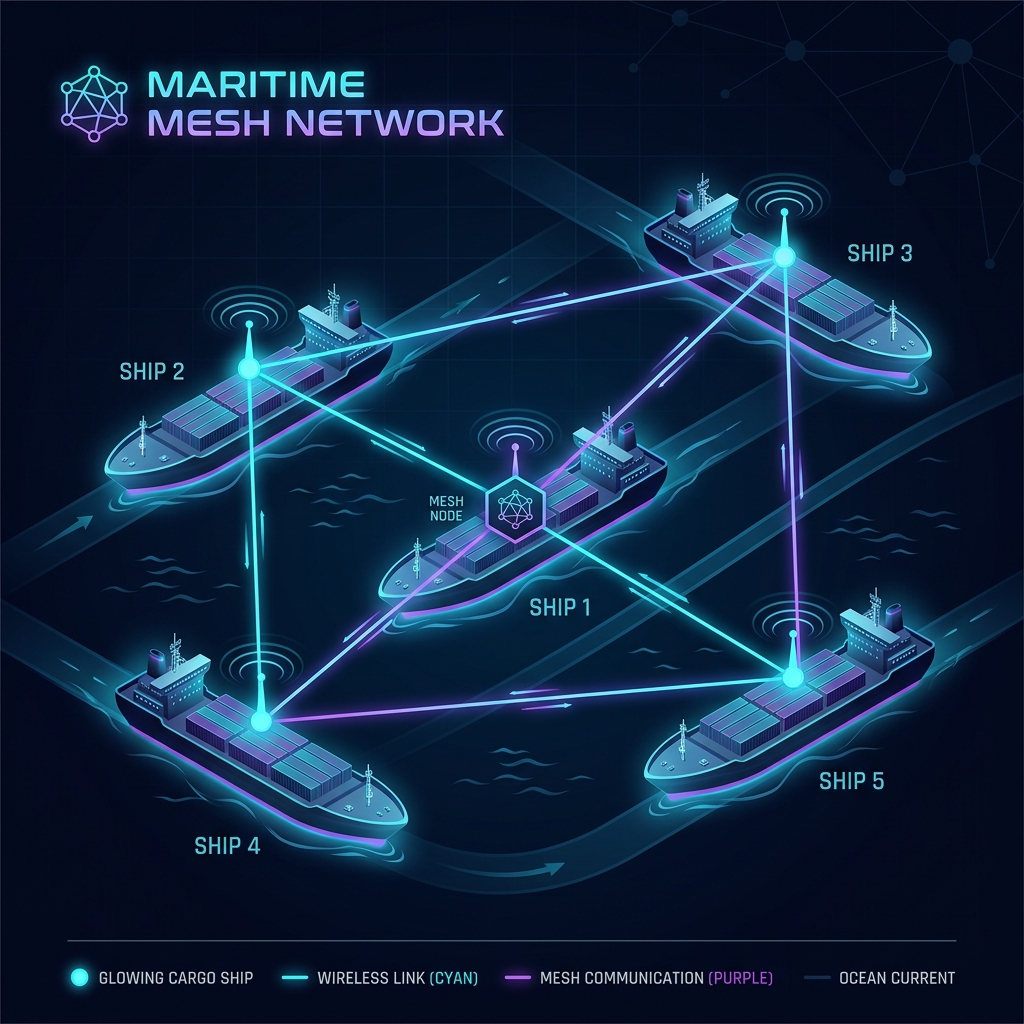
The Solution: Device-to-Device Mesh
Instead of trying to wire the entire ship with Wi-Fi repeaters, we turned the crew's existing smartphones into the network infrastructure. VeilMesh was built from the ground up to utilize Bluetooth Low Energy (BLE) and ad-hoc Wi-Fi Direct.
If Alice in the engine room needs to message Bob on the bridge, the VeilMesh protocol seamlessly routes the encrypted packet through Charlie's phone in the galley and Dave's phone in the mess hall. The data hops from device to device (multi-hop routing) until it reaches its destination.
Beyond the Sea: Critical Industries
What started as a solution for maritime shipping quickly proved essential for other extreme environments:
- Offshore Oil Rigs: Where explosive environments restrict traditional networking hardware, but intrinsic safety phones can form a dynamic mesh.
- Mining Operations: Deep underground where cellular signals cannot penetrate, but workers need instant communication.
- Disaster Recovery: When hurricanes or earthquakes wipe out local cell towers, rescue workers can drop into an area and instantly have a functioning, secure communication grid.
Zero Cost, Maximum Security
Because the network runs entirely on the devices themselves, there are zero data costs. The satellite connection is never touched. Furthermore, because VeilMesh utilizes Double Ratchet End-to-End Encryption, even if an adversary captures a device acting as a "relay hop," the data remains mathematically unreadable.
VeilMesh proves that the most resilient networks aren't the ones with the biggest central servers—they are the ones with no center at all.