P2P Mesh over the Internet: WebRTC Data Channels and NAT Traversal Explained
How do you connect two isolated local mesh networks across the globe? Discover the hybrid mesh architecture bridging WebRTC peer-to-peer tunnels, NAT traversal, and offline nodes.
Building a local mesh network using Bluetooth Low Energy (BLE) or Wi-Fi Direct is an incredible engineering challenge. But what happens when you need to send a secure message from a local mesh node in Tokyo to another isolated mesh node in London? How do you route traffic globally without relying on centralized messaging servers?
This is the exact problem we solved in VeilMesh using WebRTC Data Channels. In this post, we dive deep into how we achieve serverless global routing, overcome NAT traversal, and bridge local mesh networks over the public internet.
The Challenge: NATs and Firewalls
The internet was originally designed for true peer-to-peer (P2P) communication, where every device had a public IP address. Today, however, almost all consumer devices hide behind a Network Address Translation (NAT) layer or strict firewalls. If Alice's phone wants to send a direct TCP or UDP packet to Bob's phone, the packets are instantly dropped by their home routers or cellular providers.
Legacy messengers solve this by putting a giant centralized server in the middle. Alice sends the message to the server, and Bob connects to the server to download it. But in a zero-trust, decentralized mesh network, we cannot rely on a central database holding everyone's traffic.
Enter WebRTC Data Channels
While most developers associate WebRTC with video conferencing (like Zoom or Google Meet), it contains a hidden gem: WebRTC Data Channels. This API allows for high-throughput, low-latency, encrypted P2P transfer of arbitrary binary data between browsers or native apps.
By implementing WebRTC in the VeilMesh core, we treat the global internet just like an incredibly fast Wi-Fi Direct link. An encrypted MeshPacket generated in our Rust core is simply pushed through the WebRTC data channel exactly as if it were being transmitted over local BLE.
How We Beat NAT: STUN and TURN Servers
To establish a direct WebRTC connection, devices must figure out their public IP addresses and how to bypass their routers. This is known as NAT Traversal.
- STUN (Session Traversal Utilities for NAT): First, devices ping a STUN server. The STUN server acts like a mirror, simply telling the device, "Here is the public IP and port I see you connecting from." Once both peers know their public IP mappings, they exchange this connection data (ICE Candidates) and attempt to punch a hole through their firewalls. In 80% of cases, this succeeds, establishing a direct, serverless P2P tunnel.
- TURN (Traversal Using Relays around NAT): For the remaining 20% of cases—typically involving strict corporate firewalls or symmetric NATs—direct hole-punching fails. Here, we fall back to a TURN server. The TURN server acts as a blind relay, blindly forwarding encrypted UDP packets between peers. Importantly, because VeilMesh utilizes end-to-end encryption and Proof-of-Work locally, the TURN server cannot read the messages or inject spam.
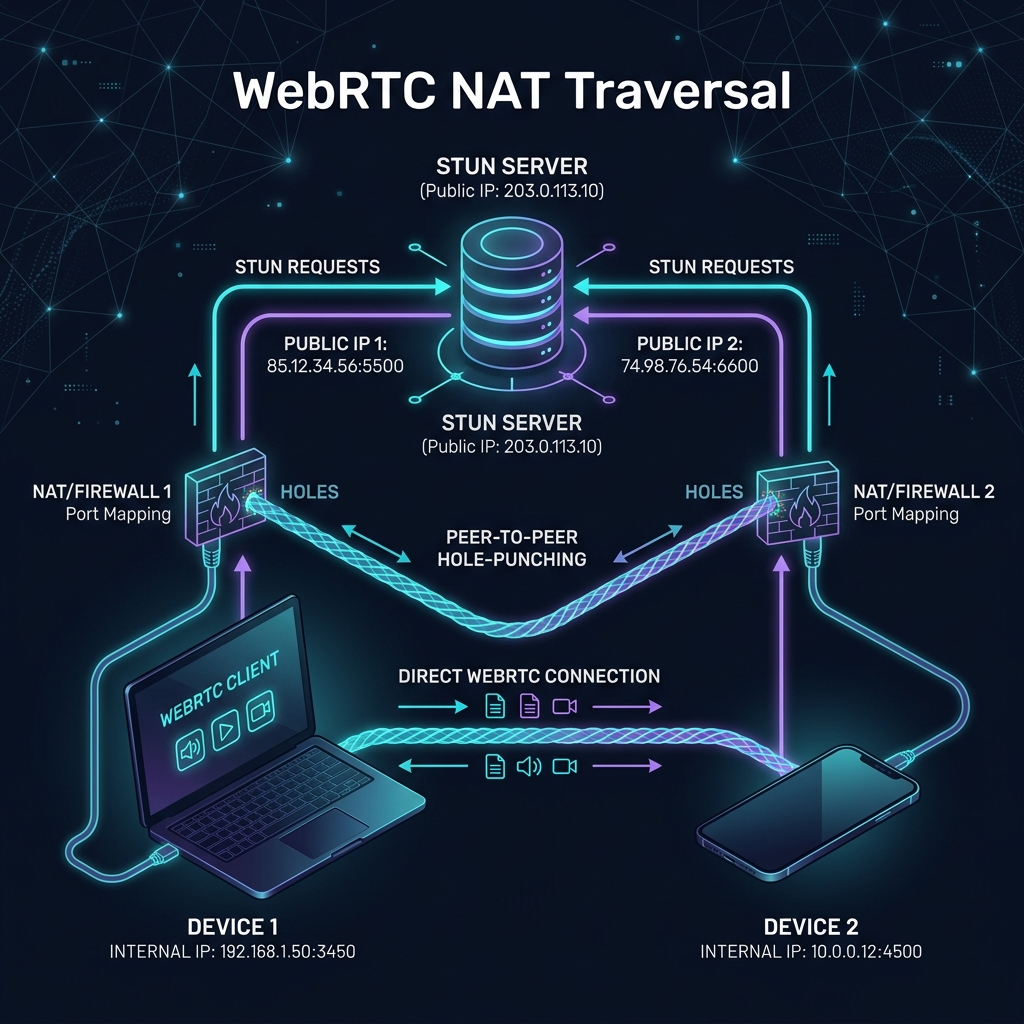
Bridging the Islands: The Gateway Concept
The true magic of VeilMesh happens when local and global routing collide. Imagine a cargo ship with 50 crew members forming a local BLE mesh network. Only one device on the ship has access to an expensive satellite internet connection.
That single device automatically promotes itself to a Gateway Node. When a crew member deep in the ship sends a message to their family on shore, the local mesh routes the packet hop-by-hop until it reaches the Gateway Node. The Gateway Node then wraps that binary MeshPacket in a WebRTC Data Channel, blasts it across the internet to the recipient, and routes the acknowledgment back down into the ship's local mesh.
This creates the core of our hybrid mesh architecture: Locally Decentralized, Globally Connected.
Conclusion
Building P2P networks over the internet is notoriously difficult due to IPv4 exhaustion and NAT strictness. By leveraging WebRTC Data Channels, VeilMesh achieves seamless global connectivity without sacrificing our core principles of zero-trust decentralization. Stay tuned for our next deep dive into the offline-first algorithms that keep our group chats synchronized!