Beyond Encryption: How VeilMesh Solves the Metadata Crisis
Most "secure" messengers still leak who you talk to and when. Discover how VeilMesh combines Zero-Knowledge blind relays, Proof-of-Work, and hybrid mesh routing to guarantee absolute anonymity.
In today's digital landscape, End-to-End Encryption (E2EE) is no longer enough. While mainstream messaging applications protect the content of your messages, they still collect massive amounts of metadata—who you talk to, when you talk to them, and your IP address. This metadata is often more valuable to data brokers and surveillance agencies than the messages themselves.
At VeilMesh, we believe true privacy requires a Zero-Trust, Zero-Knowledge architecture. Here is how we are completely eliminating the metadata honeypot.
1. The Myth of the "Secure" Centralized Server
Legacy messengers rely on centralized servers that map phone numbers to IP addresses. Even if the server cannot read your messages, it can observe the exact traffic patterns of your social graph. VeilMesh abandons this model entirely.
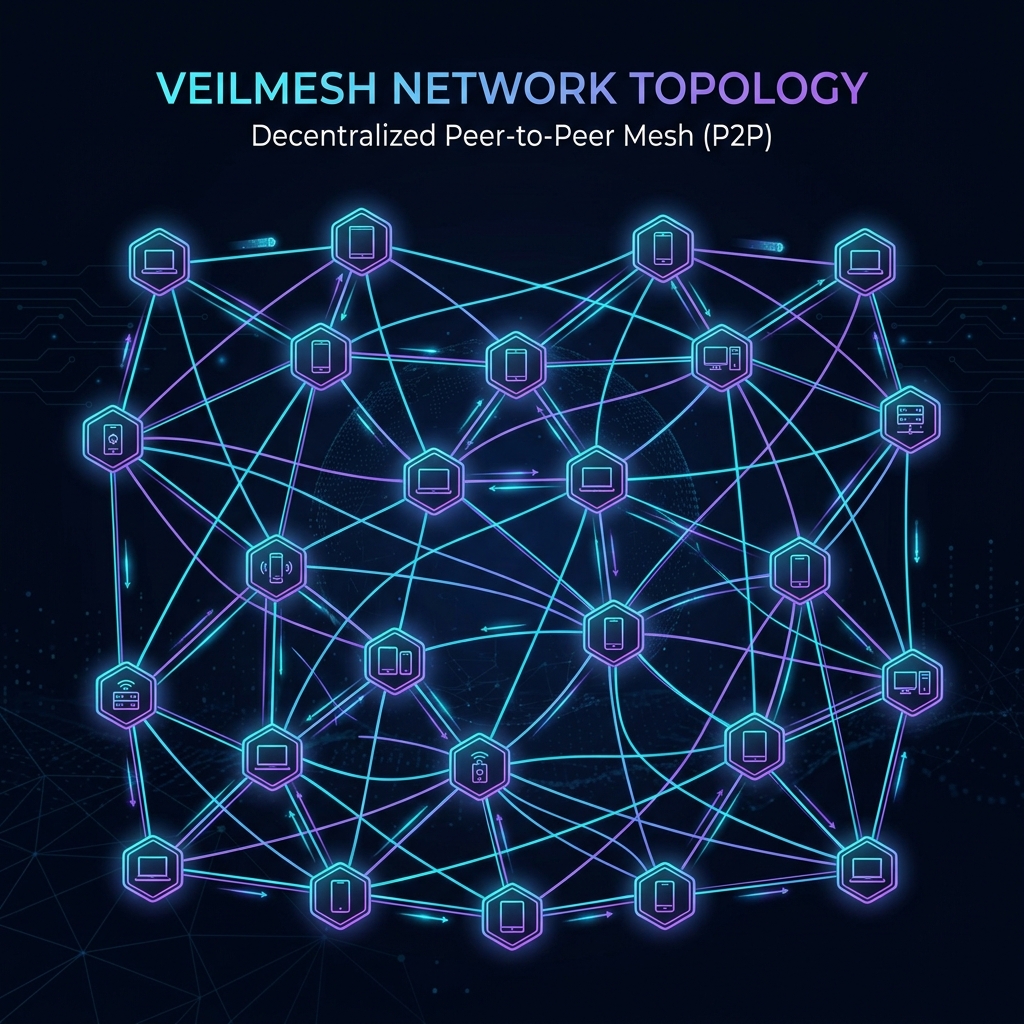
We use a hybrid mesh transport architecture. Whenever possible, VeilMesh operates in a Direct Mesh mode via BLE and Local Wi-Fi, completely bypassing ISPs and cellular towers. When distance requires a relay, our veilmesh_server acts as a mathematically "blind" router. It forwards opaque binary blobs (MeshPackets) without the cryptographic capability to inspect them.
2. Why Not Tor? The Cost of Anonymity Networks
A common question is: "Why not just route everything through Tor?" While onion routing provides excellent metadata protection, it is fundamentally incompatible with mobile-first, low-latency communication. Integrating Tor introduces massive overhead, battery drain, and connection latency (often measured in seconds). VeilMesh requires real-time voice calls and instant messaging. Instead of forcing heavy Tor nodes onto mobile devices, we built a lightweight, native mesh routing engine tailored specifically for the edge.
3. Defeating Denial of Service (DoS) with Proof-of-Work
A completely open mesh network faces a unique threat: Sybil attacks and signature spam. If an attacker floods the network with fake packets, verifying the cryptographic signatures (Ed25519) for every packet would quickly drain your phone's battery and crash the application.
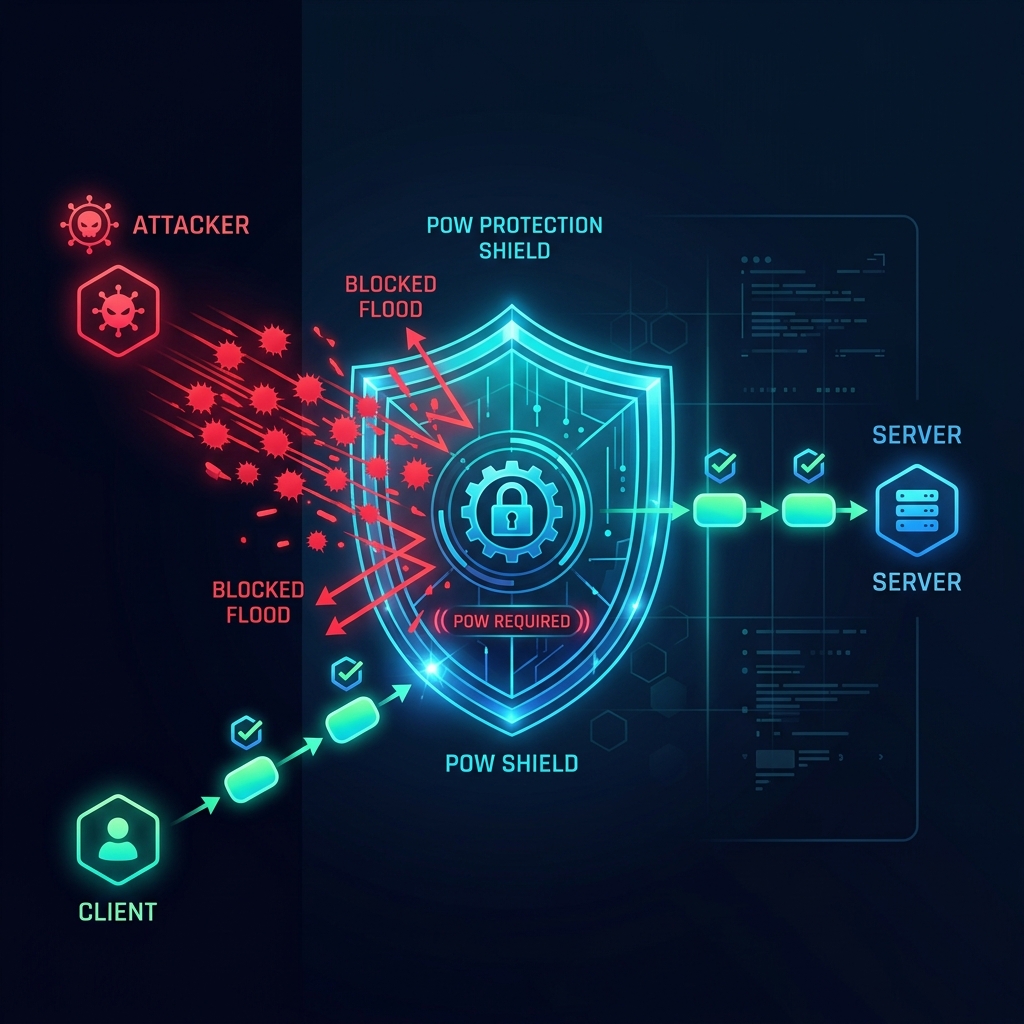
To solve this, VeilMesh implements a network-level Proof-of-Work (PoW). Before broadcasting a message, a client must solve a cryptographic puzzle (finding a SHA-256 hash with leading zeroes). Intermediate nodes can verify this puzzle in O(1) time—microseconds—instantly dropping spam without triggering the expensive cryptographic verification process.
4. Hardware-Backed Identity
Forget phone numbers and vulnerable SIM cards. Your VeilMesh identity is derived mathematically and stored securely within your device's Secure Enclave (iOS) or Keystore (Android). Your private keys never touch the cloud, and they never leave the physical silicon of your phone.
5. Reality: Sealed Sender
While our Version 1 architecture protected payload data and prevented DoS attacks, our Version 2 MeshPacket protocol already implements Sealed Sender technology natively. Instead of heavy onion routing, we utilize ChaCha20 stream ciphers to mathematically obfuscate both the sender's public key and the packet ID during transit. This ensures that the relay server is 100% blind to both the origin and destination of all traffic, operating with zero latency cost.
Ready to take back your digital autonomy? VeilMesh is currently in active development. Stay tuned to our blog for more engineering deep dives and release updates.