Decentralization in 2026: Marketing Speculation vs. True Sovereignty
The term "decentralization" has become a marketing umbrella for almost anything. Let’s draw the line between speculative DePIN hardware schemes and true offline-first mesh networks.
The term "decentralization" has become one of the most overused buzzwords in tech. Under its broad umbrella, companies market everything from distributed databases to play-to-earn tokens and proprietary "crypto-hardware" devices. But if we strip away the glossy slide decks and financial hype, where does the real line lie between genuine technological sovereignty and centralized systems wrapped in a blockchain veneer?
It is time to draw a clear line between two fundamentally different approaches to decentralization competing in the industry today.
1. The Illusion of Decentralization: "DePIN Marketing"
The DePIN (Decentralized Physical Infrastructure Networks) sector promises a hardware-driven infrastructure revolution. In practice, however, the user experience often boils down to a familiar pattern:
- You buy a proprietary, branded hardware "box" for $300 to $1000.
- You plug it into your home power outlet and router.
- You download a mobile app, register an account, and link your wallet.
- You wait for project tokens to accumulate in exchange for sharing bandwidth, storage, or compute power.
The Structural Trap
Despite the appealing narrative of distributed participation, these devices remain tethered to a centralized cloud architecture:
- Single Point of Dependence: The hardware boxes communicate with company-owned servers through proprietary, closed APIs and authenticate against a central database.
- Fragility: If the parent company’s servers go offline, face regulatory blocks, or if the startup goes bankrupt, your expensive hardware instantly becomes a brick.
- Speculative Incentives: The network's survival depends entirely on token valuation and speculative interest. It is centralization operating with blockchain-casino dynamics.
2. True Decentralization: "True Mesh"
At VeilMesh, we believe decentralization is not about tokenomics, nor is it about selling branded hardware boxes. It is about mathematics, local cryptography, and physical network autonomy.
Core Principles of a True Mesh:
- Autonomous Nodes: There is no central registry, DNS, or server in the middle. Every device (whether a smartphone, laptop, or microcomputer) acts as an equal router and local state coordinator.
- Zero Global Accounts: No phone numbers, emails, or KYC. Your identity is a cryptographic public key generated completely offline inside your device’s secure hardware (like the iOS Secure Enclave).
- Physical Infrastructure Independence: When cellular towers go down or the public internet fails, VeilMesh nodes communicate directly over local radio frequencies using ad-hoc Wi-Fi Direct and BLE.
- End-to-End Security (E2EE): Group communications are encrypted locally via the Message Layer Security (MLS) protocol. Intermediary nodes relaying the encrypted binary blobs (MeshPackets) have zero cryptographic visibility into the contents or metadata.
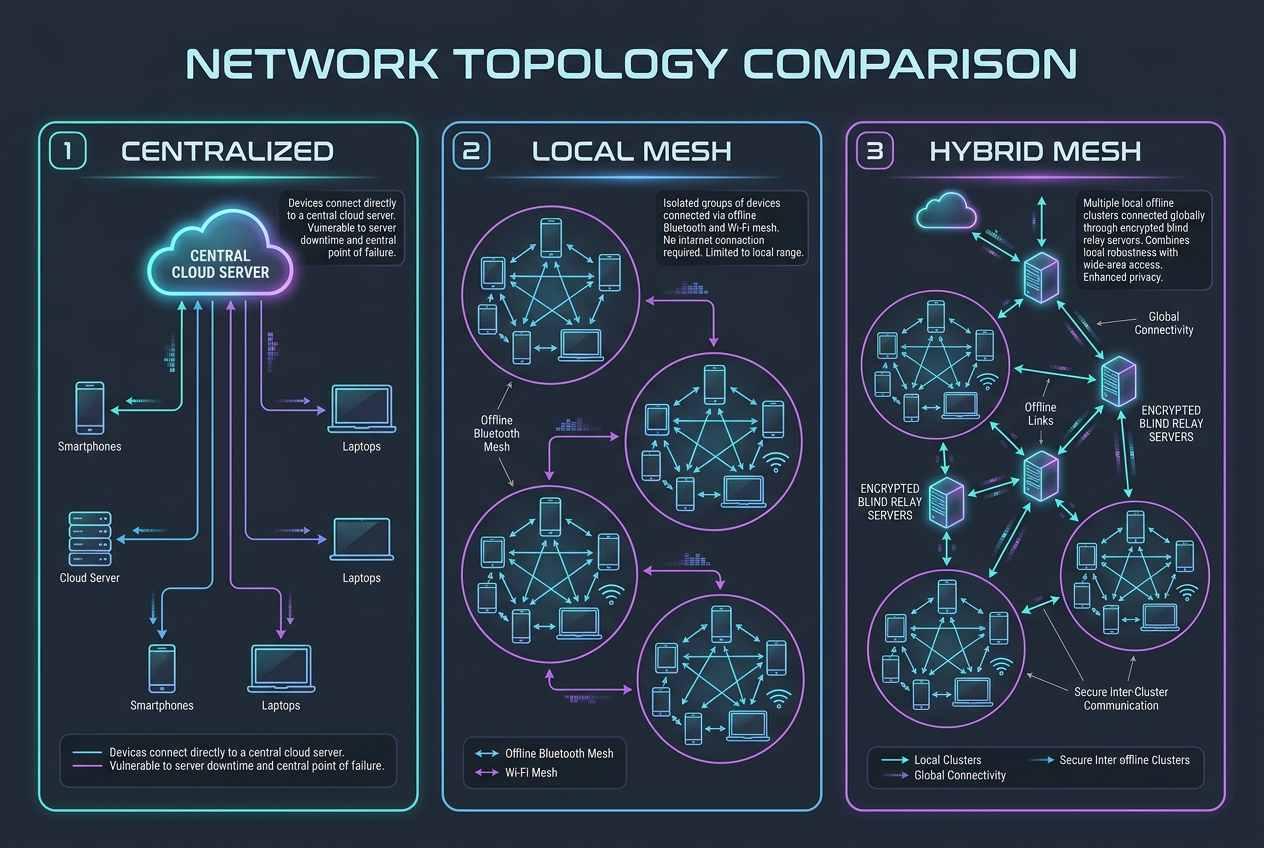
Comparing the Models
| Feature | DePIN / Cloud Centralized | True P2P Mesh (VeilMesh) |
|---|---|---|
| Primary Focus | Token speculation & financial yields | Network resilience & data sovereignty |
| Vendor Lock-in | High (bound to creator's APIs & cloud) | None (software runs fully locally) |
| Offline Functionality | Impossible (requires cloud connection) | Native (direct device-to-device links) |
| User Registration | Required (SMS, Email, or Wallet) | None (local keypairs generated on-device) |
| Single Point of Failure | Central APIs, server infrastructure, DNS | None (self-healing, peer-redundant) |
Why It Matters Today
Modern connectivity has built a deep dependency on remote, corporate-owned servers. But when natural disasters strike, infrastructure fails, or censorship blocks access, these centralized systems are the first to collapse.
True decentralization is not about turning your router into a speculative mining machine. It is about retaining absolute control over your communications and data when everything else goes offline.
We are building VeilMesh to ensure that you own your connection, your identity, and your security—directly, mathematically, and unconditionally.